
Template
Free Incident Report Template for Construction Teams
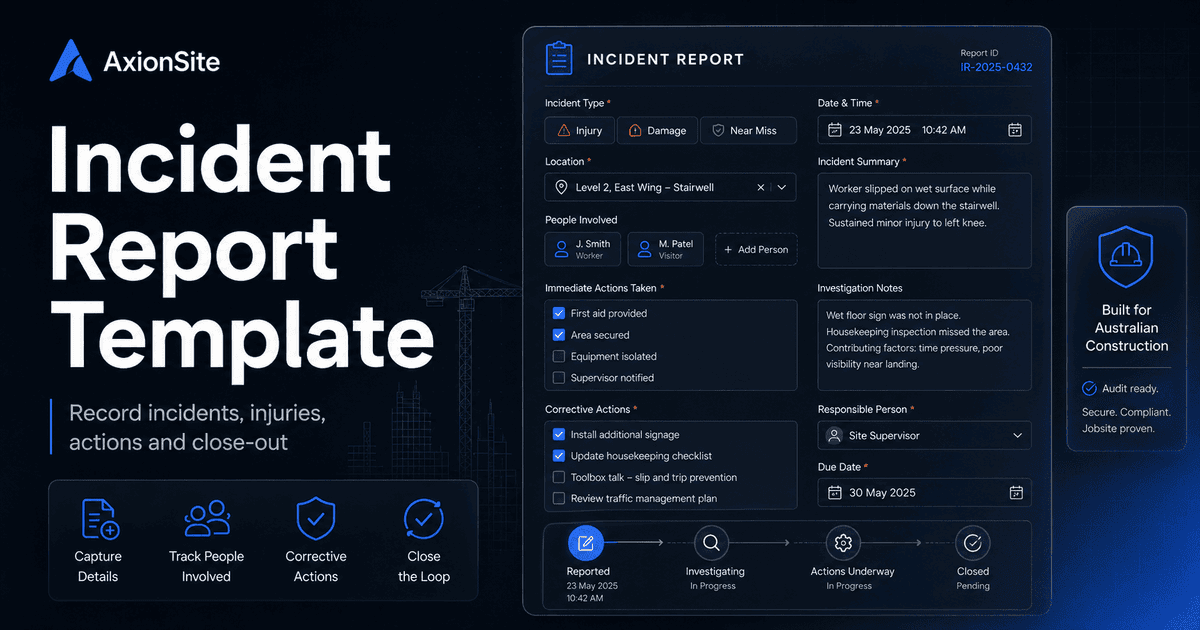
Outline for incident records: people involved, injuries and damage, immediate actions, investigation, corrective actions and closure — for internal governance.
Download a printable copy
PDF for toolbox or site records, Word for adapting fields to your IMS or client requirements.
Complete the security check to enable downloads.
Incident records support immediate response, notifier decisions, insurance and learning. Keep fields structured; separate facts from early speculation; preserve attachments immutably where policy requires.
Who this helps
Supervisors, safety managers and executives preparing proportionate records after events ranging from near misses to injuries.
What this template is for
Incident records should support immediate care, make-safe decisions, internal escalation, investigation, corrective action tracking and later review. Keep the record factual and structured so it remains useful to operations, leadership and any external advisors.
How to use it
Capture the first account quickly, then update the record as facts are confirmed. Separate immediate actions from root-cause analysis, and make notification decisions through your competent safety/legal process rather than relying on generic software prompts.
Use the checklist in order: respond and make safe, record who was involved, preserve evidence, screen notification duties, investigate contributing factors, then close out corrective actions with proof they worked.
1. Immediate response and site safety
- First aid, emergency response or 000 call completed where required.
- Area is made safe without disturbing evidence more than necessary for aid, safety or emergency response.
- Incident site is preserved if the event may be notifiable, subject to regulator/police directions.
- Immediate hazards are isolated, barricaded, tagged out or controlled.
- Supervisor, site manager, principal contractor/client and WHS contact are notified according to procedure.
- Initial facts are recorded promptly: date, time, site, location, work activity and who reported it.
2. People, injury/illness and treatment details
- Injured/affected person details are recorded only to the extent required by policy and privacy rules.
- Employment relationship is recorded: worker, contractor, subcontractor, visitor, member of public or other.
- Injury/illness type, body part, severity and immediate treatment are recorded where relevant.
- Medical treatment, hospital attendance/admission or ambulance details are recorded where known.
- Witness names/contact details are recorded, with statements collected respectfully and separately where appropriate.
- Psychological hazards, violence, harassment or sensitive matters are handled confidentially and escalated through competent channels.
3. Event description and evidence
- Plain factual description records what happened, where, when and what work was underway.
- Incident type is classified: injury/illness, near miss, dangerous incident, property damage, environmental event or security/public event.
- Plant, equipment, vehicles, substances, tools, materials or structures involved are identified.
- Photos, CCTV references, permits, SWMS, pre-starts, training records or inspection records are attached where appropriate.
- Known facts are separated from assumptions, opinions and root-cause hypotheses.
- Timeline captures actions before, during and immediately after the event.
4. Notification and preservation decision
- Notifiable incident screening completed for death, serious injury/illness or dangerous incident under applicable WHS law.
- Regulator notification decision is recorded with reviewer name, role, time and rationale.
- If notification is required, regulator contacted immediately after the PCBU becomes aware, using the correct state/territory process.
- Incident site preservation instructions are recorded and communicated.
- Workers compensation insurer/client/internal executive notifications are completed where required.
- Copies of relevant SWMS, risk assessments, permits and WHS management records are preserved according to legal and organisational requirements.
5. Investigation and contributing factors
- Investigation lead and participants are assigned, including worker/HSR consultation where appropriate.
- Direct causes and contributing factors are reviewed: environment, plant, procedure, supervision, training, fatigue, communication, design or scheduling.
- Existing controls are checked against what was planned in SWMS, permits, inspection records or site rules.
- Control failure is described specifically, not blamed on generic worker behaviour.
- Relevant similar incidents, hazards or inspection findings are reviewed for repeat patterns.
- Investigation findings are approved by a competent person before corrective actions are closed.
6. Corrective actions and close-out
- Immediate corrective actions and long-term preventive actions are separated.
- Each action has an owner, due date, priority and verification method.
- Higher-order controls are considered before relying on training, signage or PPE.
- SWMS, permits, induction content, toolbox talks or inspection checklists are updated where required.
- Workers affected by the change are briefed before work resumes or continues.
- Close-out evidence is attached and the record shows who verified effectiveness and when.
Best-practice notes
Your PCBU — not software — determines notifiable incident obligations under WHS law. Tools can surface conservative prompts; they must not replace regulator legal advice.
Related: Hazard report template · Construction safety software Australia.