
Template
Free Contractor Compliance Checklist for Australian Construction Teams
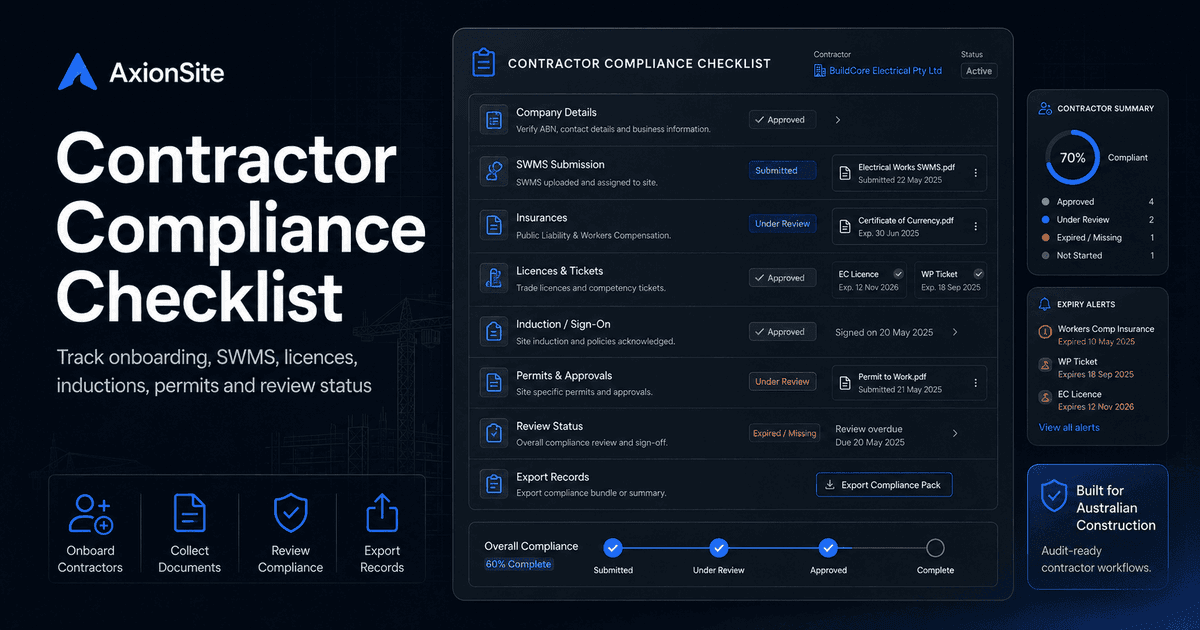
Checklist for subcontractor onboarding: SWMS submissions, insurances, induction, permits, site rules and exportable records.
Download a printable copy
PDF for toolbox or site records, Word for adapting fields to your IMS or client requirements.
Complete the security check to enable downloads.
Principal contractors and clients need subcontractors to arrive documented, inducted and aligned to site rules — without losing email threads. This checklist supports onboarding reviews and gate checks before access is granted.
Who this helps
Construction managers, commercial teams and WHS staff coordinating many subcontractors across programmes.
What this checklist is for
Contractor compliance is more than collecting certificates. It should show who is doing the work, what documents were submitted, who reviewed them, what conditions apply on site and how records can be retrieved during an audit or client review.
How to use it
Use this checklist before access is granted and again when scope changes. Keep SWMS submissions, insurance/licence currency, inductions, permits and review status in a place supervisors can actually access, not only in procurement email threads.
The checklist is organised as a gate: confirm the contractor's identity and scope, verify documents and licences, review the SWMS, induct the workers, then monitor the work and preserve evidence for audit or handover.
1. Contractor identity and scope
- Legal entity name, ABN/ACN, trading name and primary contact recorded.
- Contracted work scope, location, expected dates and work stages are clear.
- Subcontractors, labour hire or other contractor-chain participants are identified.
- Principal contractor / client contact and site supervisor contact are recorded.
- Contractor has confirmed who controls and supervises the work on site.
2. Insurance, licences and competency evidence
- Public liability, workers compensation and other required insurances are current and match the work scope.
- High Risk Work Licences are checked for crane, dogging, rigging, EWP, forklift, scaffolding or other licensed work.
- Trade licences, registrations or authorisations are checked where electrical, plumbing, asbestos, demolition or specialist work applies.
- White cards / general construction induction cards are current for workers attending site.
- Training records or competency evidence are available for plant, tools, isolation, height safety, confined space or traffic control tasks.
- Expiry dates, verification method and reviewer name/date are recorded.
3. SWMS and high-risk construction work review
- High-risk construction work triggers have been checked before work starts.
- SWMS is supplied by the contractor/person carrying out the high-risk construction work where required.
- SWMS describes the actual task, sequence, location, plant/tools, hazards and controls, not just generic company wording.
- Controls address the hierarchy of controls and include how they will be implemented and checked on site.
- SWMS references permits, rescue plans, isolation, exclusion zones, traffic/public interface or environmental controls where relevant.
- Workers who will perform the work were consulted or briefed before the SWMS was accepted.
- SWMS review decision is recorded: accepted, accepted with conditions, revise before access, or rejected.
4. Site induction and access gate
- Site-specific induction completed before the worker starts work.
- Emergency procedures, first aid, amenities, evacuation/muster point and incident reporting pathway explained.
- Site rules, PPE requirements, restricted areas, traffic routes and public-interface controls explained.
- Worker has signed/acknowledged the current SWMS, site rules and relevant permits.
- Visitor, short-term worker and delivery-driver access rules are defined.
- Access is withheld or restricted until required documents and inductions are complete.
5. Permits, plant and specialist controls
- Required permits are identified: hot work, confined space, excavation, electrical isolation, lifting, roof access or traffic as applicable.
- Permit issuer, approver, expiry, handback and close-out requirements are recorded.
- Plant/equipment inspection, pre-start, maintenance and registration evidence is available where relevant.
- Electrical leads, RCDs, test-and-tag status and isolation/LOTO controls are checked where relevant.
- Lift plans, ground bearing, exclusion zones and dogger/rigger arrangements are checked before lifting work.
- Traffic management plans, pedestrian separation and road authority/client requirements are checked where work affects roads or public areas.
6. Consultation, cooperation and coordination
- Interfaces with other PCBUs, trades, tenants, public areas or client operations are identified.
- Shared hazards are discussed with affected duty holders before work starts.
- Daily pre-start/toolbox communication covers work fronts, changes, exclusions and simultaneous operations.
- Contractor knows how to stop work and escalate if a control is missing, impractical or not followed.
- Changes in scope, sequence, plant, subcontractors or site conditions trigger a document and briefing review.
7. Monitoring, non-conformance and incident response
- Supervisor or nominated reviewer checks the contractor is working to the accepted SWMS and site rules.
- Inspection/audit frequency is proportionate to the risk and level of site control.
- Non-conformances, missing documents, expired licences or unsafe work observations are recorded with owners and due dates.
- Corrective actions are verified before the issue is closed.
- Incident, near miss or notifiable-incident escalation process is understood by contractor and site team.
- Regulator/client notifications are reviewed through the competent WHS/legal process where required.
8. Records, evidence and close-out
- Accepted SWMS, permits, inductions, licences, insurance, toolbox talks and sign-ons are stored in a retrievable location.
- Version history shows what changed, who reviewed it and when workers were briefed.
- Photos, inspection results, permit handbacks and corrective-action evidence are linked to the contractor/job where possible.
- Close-out confirms work completed, controls removed/made safe and outstanding actions transferred to the responsible owner.
- Audit/export pack can be produced for client, principal contractor, insurer or regulator review.
Compare platforms: HammerTech alternative guide.