
SWMS vs JSA vs Safe Operating Procedure: What Australian Construction Teams Need
SWMS is legally required for high-risk construction work only. How JSAs, JSEAs, SOPs and risk assessments differ — when to use each, and avoiding template confusion.
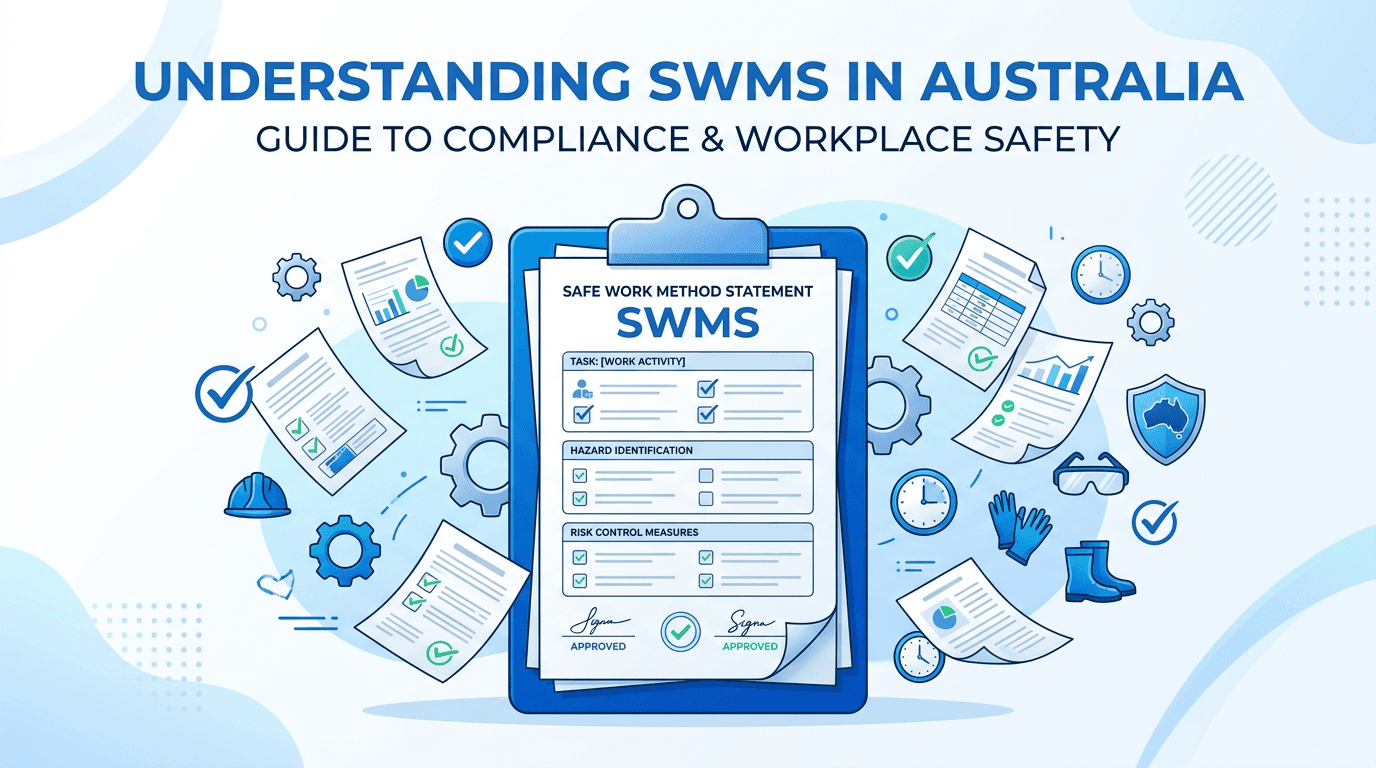
Quick answer: A SWMS (Safe Work Method Statement) is legally required for high-risk construction work (HRCW) under WHS Regulations before that work starts. A JSA (Job Safety Analysis) or JSEA is a general risk assessment tool — useful for non-HRCW tasks or as a supporting document, but not a substitute for a SWMS when HRCW applies. A Safe Operating Procedure (SOP) or Safe Work Procedure (SWP) describes how to operate plant or perform a routine task — it does not satisfy SWMS duties for HRCW unless it meets Reg 299 content and is managed as a SWMS.
Confusion between these documents causes missing SWMS on site — one of the most common enforcement findings.
Document comparison table
| Document | Legal mandate (construction) | Typical use | Reg 299 SWMS content? |
|---|---|---|---|
| SWMS | Yes for HRCW | High-risk tasks — falls, trenches, demo, confined space | Must meet Reg 299 |
| JSA / JSEA | No (unless site policy) | General task hazard ID — lower risk work | Only if structured as compliant SWMS |
| SOP / SWP | No (unless plant regs require) | Standard operation of equipment | No — unless adapted & issued as SWMS |
| Risk assessment | General duty (risk management) | Broad hazard register, design phase | Supporting evidence only |
| Permit-to-work | Often policy / HRCW controls | Authorise specific high-risk execution | Complements SWMS |
Swipe to see all columns →
Safe Work Australia states a SWMS is different from generic documents like JSAs or SOPs — it is site-specific, task-specific, and tied to HRCW.
When clients ask for "a JSA" but law requires SWMS
Many principal contractors use legacy language — "send your JSA"* — meaning any safety document. If the task is HRCW, insist on SWMS meeting Reg 299, regardless of filename. Submitting a one-page JSA for roof work at 3m exposes both* subcontractor and principal contractor to enforcement risk.
Can one document serve multiple purposes?
Yes — if content satisfies Reg 299 and is managed as a SWMS:
Some teams embed JSA-style step analysis inside a SWMS table — that is good practice, not a separate legal category.
SOPs and plant
Plant operators may follow SOPs for normal operation. Non-routine maintenance or construction HRCW (e.g. mobile plant near overhead lines) still triggers SWMS where Reg 291 applies. Pre-start checklists complement but do not replace SWMS.
Site policy vs law
Sites often require JSAs for all tasks — stricter than law. Comply with contract requirements and WHS Regulations. The stricter SWMS obligation wins when HRCW applies.
Avoiding "document theatre"
Multiple overlapping forms with contradictory controls confuse workers and fail audits. Prefer one connected system:
Real-world naming confusion on Australian sites
| What the client says | What law may require |
|---|---|
| "Send your JSA" | SWMS if HRCW (Reg 299) |
| "Safe work procedure for roof" | SWMS with HRCW identification |
| "Risk assessment only" | May be insufficient for HRCW |
| "Method statement" (UK term) | Often maps to SWMS in AU construction |
Swipe to see all columns →
Principal contractor WHS management plans should use consistent terminology in subcontractor packs — but subcontractors must still meet Reg 299 content regardless of filename.
Reg 299 content checklist (SWMS only)
If the document is your legal SWMS, it must include:
JSAs that only list "hazard / control / PPE" without implementation/monitoring language may fail prosecution scrutiny even if HRCW was obvious.
FAQ
Can my ERP system rename SWMS to JSEA? Filename does not matter — content and management do.
Does a crane lift plan replace SWMS? No — lift plans complement SWMS where both HRCW (e.g. mobile plant near overhead lines) and lifting operations apply.
AxionSite: one platform for HRCW — not document confusion
AxionSite is built around SWMS for high-risk work — everything else connects to it:
The platform prompts for HRCW indicators so you never skip a SWMS because the template was titled "JSA."
Sources
Ready to automate your WHS compliance?
Watch the short walkthrough on our AxionSite product page—the same flow from site details through SWMS generation, sign-off, PDF export, and crew sign-on—then start your trial when you’re ready.