
Section 27 Due Diligence for Construction Directors: Evidence Courts Expect in 2026
Officers must exercise due diligence under WHS Act s 27. Six elements explained for construction, prosecution patterns, and what verification evidence looks like with connected safety data.
Quick answer: Under Section 27 of the model WHS Act, officers (directors, CEOs, partners with substantial decision-making power) must exercise due diligence to ensure the PCBU complies with its WHS duties. Due diligence is personal, proactive and non-delegable — you may delegate tasks, but not the obligation to verify systems work. Courts expect evidence of verification: board papers, site visits, review of safety reports, funding decisions, and follow-up on incidents — not passive reliance on "our safety manager handles it."
This guide maps the six due diligence elements to construction reality and explains how connected compliance data supports officer governance in 2026.
Who is an "officer"?
Section 27 applies to officers of the PCBU as defined in the Corporations Act and extended definitions — typically:
Site supervisors are usually not officers — but they hold PCBU worker duties and operational safety responsibilities.
The six elements of due diligence (s 27(5))
| # | Element | Construction example |
|---|---|---|
| a | Acquire and keep up-to-date WHS knowledge | Regulator updates (SA 2m rule, NSW PINs, psychosocial codes), industry alerts |
| b | Understand operations and hazards | Site walks, review of HRCW register, major project risk profiles |
| c | Ensure resources and processes to eliminate/minimise risks | Budget for edge protection, safety staff, digital SWMS/sign-on systems |
| d | Ensure information flow on incidents, hazards, risks | Incident notification, hazard reports, subcontractor non-conformance escalated to leadership |
| e | Ensure compliance processes exist and run | SWMS review, inductions, permits, notifiable incident procedures |
| f | Verify resources and processes are provided and used | Audit inspection results, sign-on rates, action close-out, management review minutes |
Swipe to see all columns →
Element (f) is where prosecutions often hinge: systems existed on paper but nobody checked they worked.
Case patterns: acquittal vs conviction
SafeWork NSW v Mitchell Doble [2024] NSWDC 58 — director acquitted on due diligence despite company breach. Evidence: dedicated safety manager, regular reporting, site visits, active follow-up on WHS concerns. Court accepted due diligence does not require officers to personally implement controls — but to ensure systems exist and are verified.
Contrast with matters where officers never reviewed SWMS quality, cut safety budget despite known height risks, or ignored repeated subcontractor deficiencies — personal convictions and substantial fines follow.
Psychosocial enforcement is accelerating. In NSW, psychosocial duties under Reg 55A–55D (WHS Regulation 2025) require hierarchy of controls — not policies alone. From 1 July 2026, section 26A makes codes of practice enforceable benchmarks — officers face governance scrutiny on whether systems actually manage psychosocial hazards, not only physical ones.
Board reporting template (quarterly minimum)
Structure executive safety reports around s 27(5) elements:
Attach metrics, not narratives alone: "94% of active HRCW workers signed current SWMS version as of [date]" beats "SWMS process is robust."
FAQ
Can I delegate due diligence to a safety manager? You can delegate tasks — not the obligation to verify. Officers must still actively enquire and ensure systems work.
Are small builders' directors at risk? Yes — Section 27 applies by role, not company size. Sole-director builders are often both officer and operational PCBU.
Does ISO 45001 certification satisfy s 27? It supports due diligence evidence but does not replace it — certification with failing site practices still prosecutes.
Construction-specific verification checklist
Officers and boards should be able to produce:
Principal contractors and client-side officers
If you engage a principal contractor on a construction project, officers of the client PCBU still owe due diligence — assessing contractor capability before appointment and monitoring delivery. Safetysure and Comcare guidance treat documented prequalification as direct due diligence evidence.
Recent prosecution themes (2024–2026)
| Theme | Officer exposure |
|---|---|
| Falls / SWMS not addressing task | Company + individual fines; SWMS quality is governance issue |
| Silica / dust controls | Increasing scrutiny ahead of WEL transition |
| Psychosocial hazards | NSW Reg 55A–55D + enforceable codes from Jul 2026 |
| Contractor management | Failure to verify subcontractor SWMS and licences |
Swipe to see all columns →
SafeWork NSW v Mitchell Doble [2024] NSWDC 58 remains the key acquittal reference — active verification, site visits, resourced safety function. Contrast with matters where leadership never reviewed safety data despite repeated incidents.
AxionSite Intelligence Centre: due diligence you can show the board
Officers need verification, not another policy binder. AxionSite's Intelligence Centre turns live site data into the executive view Section 27 demands:
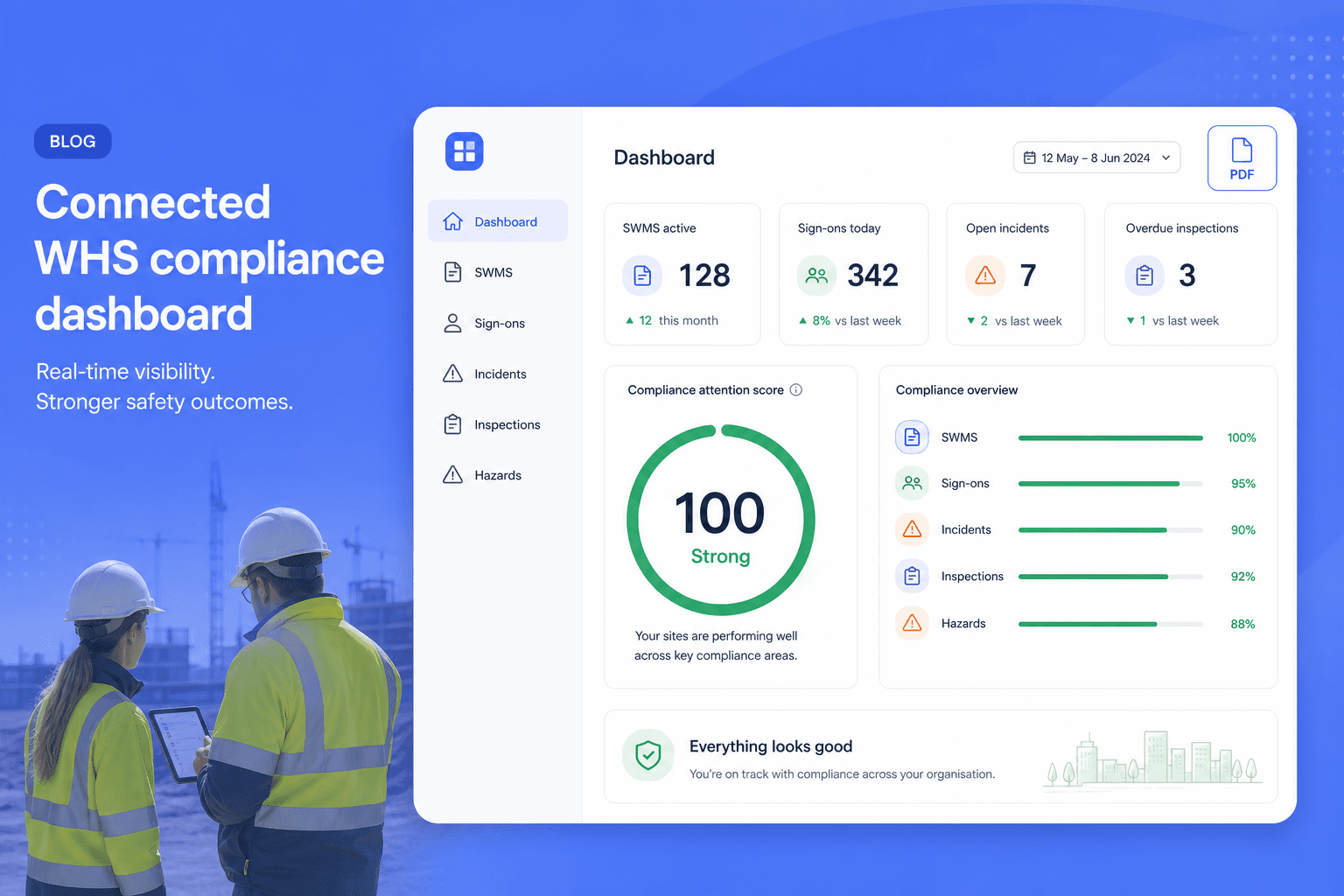
Directors who can open AxionSite and see SWMS, sign-ons, contractors and incidents in one cockpit are doing due diligence — not guessing from monthly email summaries.
Sources
Ready to automate your WHS compliance?
Watch the short walkthrough on our AxionSite product page—the same flow from site details through SWMS generation, sign-off, PDF export, and crew sign-on—then start your trial when you’re ready.