
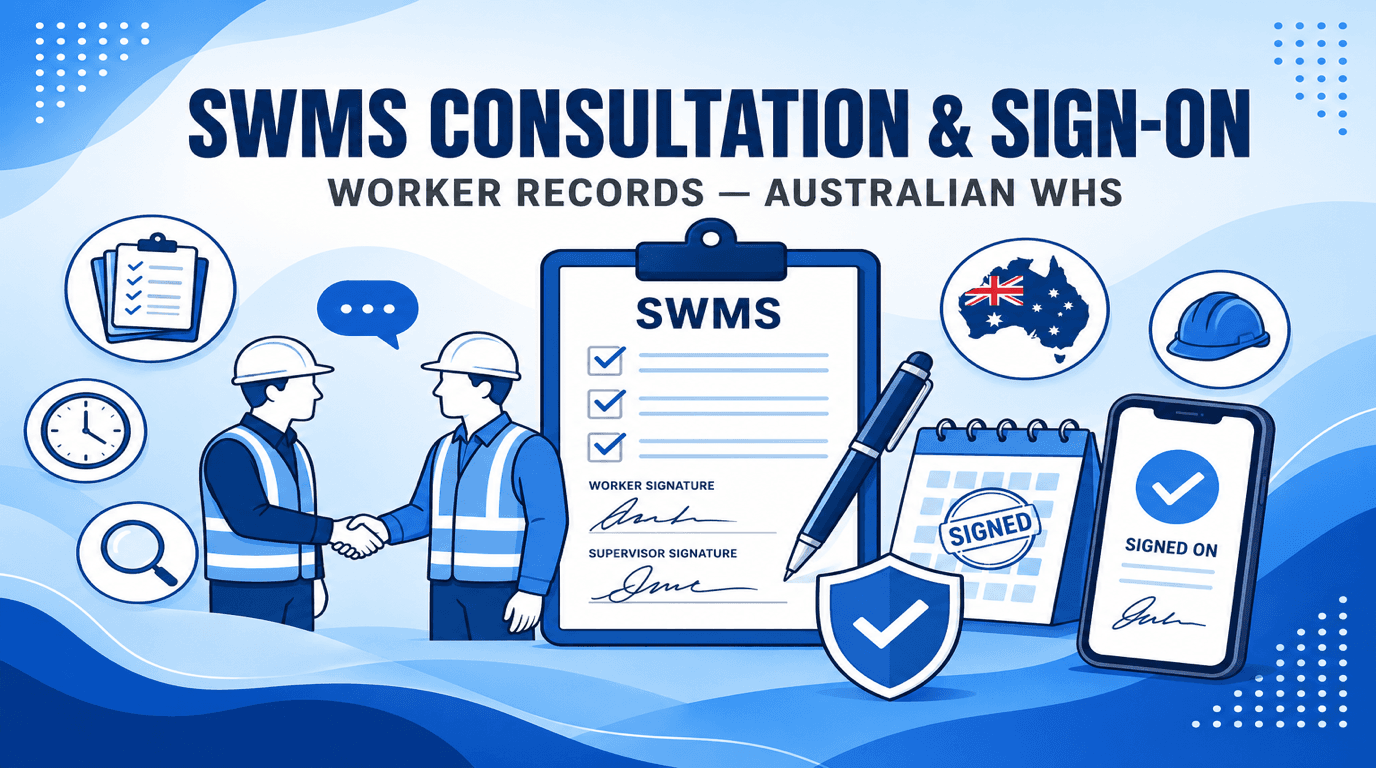
SWMS Consultation, Worker Instruction, and Sign-On Records in Australia (What Safe Work Australia Actually Says)
SWMS consultation and worker sign-on in Australia: principal-contractor handover, the SWMS on site, and audit-ready records against Safe Work Australia guidance and your state or territory WHS/OHS law.
Australian search queries are full of variants of the same worry: “Is signing a SWMS mandatory?”, “Who must sign?”, “Do workers have to sign before starting?”
Those questions mix three different ideas that tend to get blurred on site:
This article follows Safe Work Australia’s official Information Sheet — Safe Work Method Statements for High Risk Construction Work* and the model WHS Regulations / corresponding state and territory WHS Regulations, especially the high-risk construction work SWMS provisions. It is a general explainer for competent-person review, not* workplace-specific legal advice.
Requirements are broadly harmonised across most Australian jurisdictions, but businesses should always check the WHS/OHS regulator and legislation applying in their state or territory, especially where local wording or regulator guidance differs.
1. Consultation: who prepares the SWMS, and with whom?
Safe Work Australia is explicit:
Separately, the Model Work Health and Safety Act and Model WHS Regulations — as implemented in the relevant state or territory, especially the consultation duties and the high-risk construction work SWMS provisions — frame how those duties operate in harmonised jurisdictions. Regulators and guidance often refer back to the model* instruments, including consultation duties (commonly discussed using Division 3 concepts from the model Act). Your procedures should reflect the Act and Regulations as they apply where you work—not the model text in the abstract.*
Practical takeaway: If your “SWMS process” is only a template completed by someone off-site, with no evidence of worker involvement, you are not aligned with what Safe Work Australia describes as good practice—and you may struggle to demonstrate consultation under the Act that applies to you.
Workers also need suitable instruction so high-risk construction work is carried out in line with the SWMS. Tools like AxionSite can help with workflows, consultation evidence, sign-on history, versioned packs and audit-ready records—they do not replace your duty to consult, supervise, and keep controls effective on the day.
2. Principal contractor handover: before work starts
Safe Work Australia states:
This is why “we’ll sign tomorrow” / “the SWMS is in the ute” patterns create enforcement risk. The regulatory expectation is prior possession and prior preparation.
3. Understanding and compliance: the operational heart of the SWMS rules
Safe Work Australia summarises the operational chain for high-risk construction work as:
Also remember: a SWMS must be easily understood by workers, including workers from non–English speaking backgrounds.
Practical takeaway: “Compliance” is not a filing cabinet problem—it is a work-as-documented problem.
4. Where does “signing” fit?
Safe Work Australia’s information sheet (quoted above) emphasises consultation, preparation before work starts, understandability, and compliance / review. It does not replace your regulator’s full legal text on every administrative step.
In industry, worker sign-on — paper or digital — is widely used because it helps create a review-ready record that workers were consulted, instructed, given access to the relevant SWMS, and understood the controls before starting high-risk construction work.
A signed SWMS can support the evidence trail, but compliance still depends on consultation, instruction, suitable controls, work being carried out in accordance with the SWMS, and review when conditions or controls change.
That record tends to matter most:
Digital acknowledgement (typed name, drawn signature, timestamped mobile flow) can support that record—subject to your organisation’s evidence rules and any applicable electronic transactions laws. Digital sign-on does not replace the consultation duty. It helps prove that the consultation, instruction, access and acknowledgement process happened. Many Australian businesses look to the Electronic Transactions Act 1999 (Cth) framework and equivalent state/territory laws for valid electronic signatures, but implementation details (identity, integrity, retention) still matter for evidence, not as a shortcut around consultation or suitable controls.
Do not over-claim: if someone tells you a specific Regulation “X” “requires a wet signature on page 7,” ask for the jurisdiction-specific citation. The durable compliance goal is: consultation occurred, risks were understood, work matched the SWMS, and you can show it.
4A. SWMS sign-on is not site induction
These get mixed up on site. They are different duties, often owned by different PCBUs:
A subcontractor using software only to collect SWMS acknowledgements is often not the party inducting the host site. A tick that says “I have been inducted” is a self-declaration, not proof that an induction was delivered. Digital SWMS sign-on should still work when induction is done by the host, on paper, in another system, or later the same day.
If the same organisation does* run site induction in the same platform and wants sign-on to wait until that record exists, that is a site-access policy choice* — not a substitute for either duty.
5. Records that auditors (and your future self) will ask for
Competent safety teams often keep contemporaneous evidence of:
Safe Work Australia also notes the SWMS should be kept at the workplace or available to be delivered quickly, and may be stored electronically. Systems that keep timestamps, versions and sign-on history—such as AxionSite’s workflow—can strengthen audit readiness, alongside competent human review of the SWMS itself.
The practical takeaway is simple: a SWMS should not just be generated and stored. It should be communicated, understood, followed, reviewed and recorded. That is where digital consultation and sign-on records become valuable — not because the signature itself is the whole legal obligation, but because it helps show the process was actually completed.
References (primary / authoritative)
This article is general information only and is not legal advice. Always check the WHS/OHS requirements that apply in your state or territory and seek professional advice for your specific workplace.
Ready to automate your WHS compliance?
Watch the short walkthrough on our AxionSite product page—the same flow from site details through SWMS generation, sign-off, PDF export, and crew sign-on—then start your trial when you’re ready.